
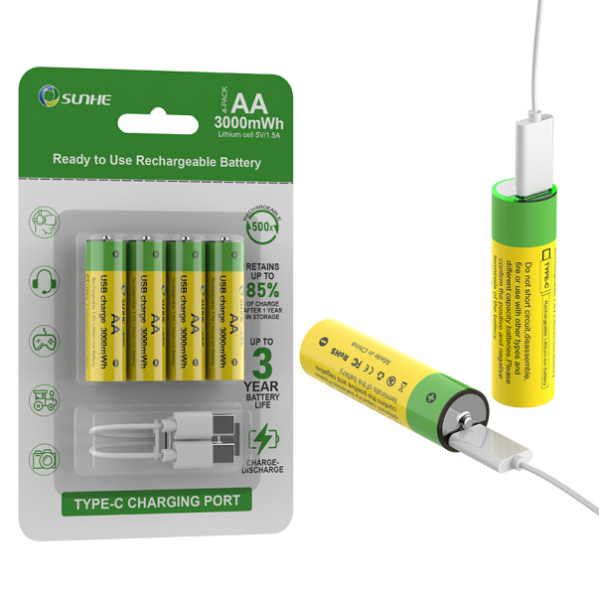
# AA Rechargeable Lithium Battery Product Details

I. Basic Product Information
Product Name: AA Rechargeable Lithium Battery (General Name: AA Rechargeable Lithium Battery)
Common Models: AA-1800mAh, AA-2000mAh, AA-2500mAh, AA-3000mAh (Models are usually labeled with "AA" + capacity; different brands may have unique codes)
Voltage Specification: 1.5V

Product Material: Mainstream are ternary lithium (lithium nickel cobalt manganese oxide) and lithium iron phosphate; some entry-level models use lithium-thionyl chloride (Li-SOCl₂) material (suitable for low-power devices)
Product Applications: Home consumer electronics, small appliances, toys, office equipment, outdoor portable devices, etc.
II. Product Overview
This product is a standard AA-sized (approximately 14mm in diameter and 50mm in height) cylindrical rechargeable lithium battery with a nominal capacity ranging from 1800mAh to 3000mAh. The core materials are primarily ternary lithium and lithium iron phosphate, suitable for electronic devices requiring 3.7V/3.2V voltage. Its standardized cylindrical structure offers versatility and compatibility, requiring no customization to fit most devices on the market that use AA batteries. This solves the pain points of disposable AA batteries: frequent replacements, high cost, and environmental pollution. Stable charge/discharge performance (cycle life generally reaches 500-1200 cycles) and wide temperature adaptability (normal operating range -20℃ to 60℃) can meet the long-term power supply needs of various scenarios such as daily household use, outdoor emergency use, and children's toys, providing continuous and economical power support for small electronic devices.
III. Core Advantages
1. High Versatility:
Adhering to the international standard size of AA batteries, no adaptation or modification is required. It can directly replace disposable AA batteries and is compatible with most "AA battery compatible devices" such as remote controls, electric toys, wireless mice, flashlights, and small radios, making it suitable for a wide range of scenarios.
2. Outstanding Cost-Effectiveness:
Supports cyclic charging and discharging (500-1200 times for mainstream models). Based on a cost of 0.1 yuan per charge and 1000 cycles, the total cost is only 100 yuan, far lower than using disposable AA batteries for the same period (approximately 500-800 yuan). Long-term use can significantly reduce expenses.
3. Stable and Durable Performance:
Ternary lithium battery models have a high discharge rate (supporting 1C-2C discharge, meeting the instantaneous high power requirements of toy cars, flashlights, etc.), while lithium iron phosphate models offer enhanced safety (high temperature resistance and excellent overcharge protection). Most products have built-in overcharge, over-discharge, and short-circuit protection chips to prevent damage to devices under abnormal operating conditions, and have good storage performance (approximately 80% capacity retention after 3 months of full charge storage). 4. Environmentally friendly and convenient: Compared to disposable dry-cell batteries (containing harmful substances such as mercury and cadmium), rechargeable lithium batteries do not cause heavy metal pollution and meet environmental protection requirements; they offer flexible charging methods, compatible with universal AA battery chargers (both USB and corded models), requiring no special equipment, and can be charged at home, in the office, or outdoors (with a power bank).
IV. General Industries and Sub-scenarios
(I) Core Applicable Industries: Consumer electronics, home furnishings, toy manufacturing, office supplies, outdoor equipment.
(II) Specific Sub-scenarios: --Home Consumer Electronics: TV/Air Conditioner Remote Controls, Wireless Mice/Keyboards, Portable Bluetooth Speakers, Small Flashlights, Electronic Alarm Clocks
-Children's Toys: Electric Toy Cars, Remote Control Airplanes, Electric Building Blocks, Musical Toys, Light-Up Toys
-Office Equipment: Portable Scanners, Handheld Label Printers, Wireless Microphones, Time and Attendance Devices (Backup Power)
-Outdoor and Emergency Scenarios: Outdoor Camping Flashlights, Emergency Radios, GPS Locators (Low Power Models), Portable Lie Detectors (Small Devices)
-Small Home Appliances: Mini Humidifiers, Small Fans (Desktop Models), Electric Toothbrushes (Some AA Battery Compatible Models), Water Flossers (Portable Models)
V. Warm Reminders
1. Charging Compatibility Requirements: Please use a standard AA rechargeable lithium battery charger. Do not use disposable dry-cell battery chargers (current and voltage mismatch can easily lead to overcharging and bulging). Avoid exceeding the battery's marked "charging cut-off voltage" (e.g., do not charge a 3.7V battery above 4.3V) to prevent shortening its lifespan or causing safety risks.
2. Safety Usage Guidelines: Do not squeeze or puncture the battery casing. Avoid dropping or impacting the battery. Keep away from high-temperature environments (such as stovetops or cars exposed to direct sunlight). Do not place the battery in a heat source or near heating equipment such as microwaves or ovens. When the device is not in use for an extended period, remove the battery to prevent leakage and corrosion of the device contacts.
3. Storage and Maintenance: When not in use for an extended period (more than one month), it is recommended to store the battery at 30%-50% charge (avoid full or empty storage to prevent capacity degradation) and recharge it every 3 months. The storage environment should be cool and dry (temperature 10℃-25℃, humidity ≤60%). Avoid storing the battery with metal objects (such as keys or coins) to prevent short circuits. Other precautions: Do not mix AA rechargeable lithium batteries of different brands and capacities (e.g., mixing 2000mAh and 3000mAh batteries may cause the lower capacity battery to be over-discharged); if you find that the battery is bulging, leaking, or overheating, you should stop using it immediately and dispose of it properly (do not discard it at will, it is recommended to put it in the "hazardous waste" recycling bin).